

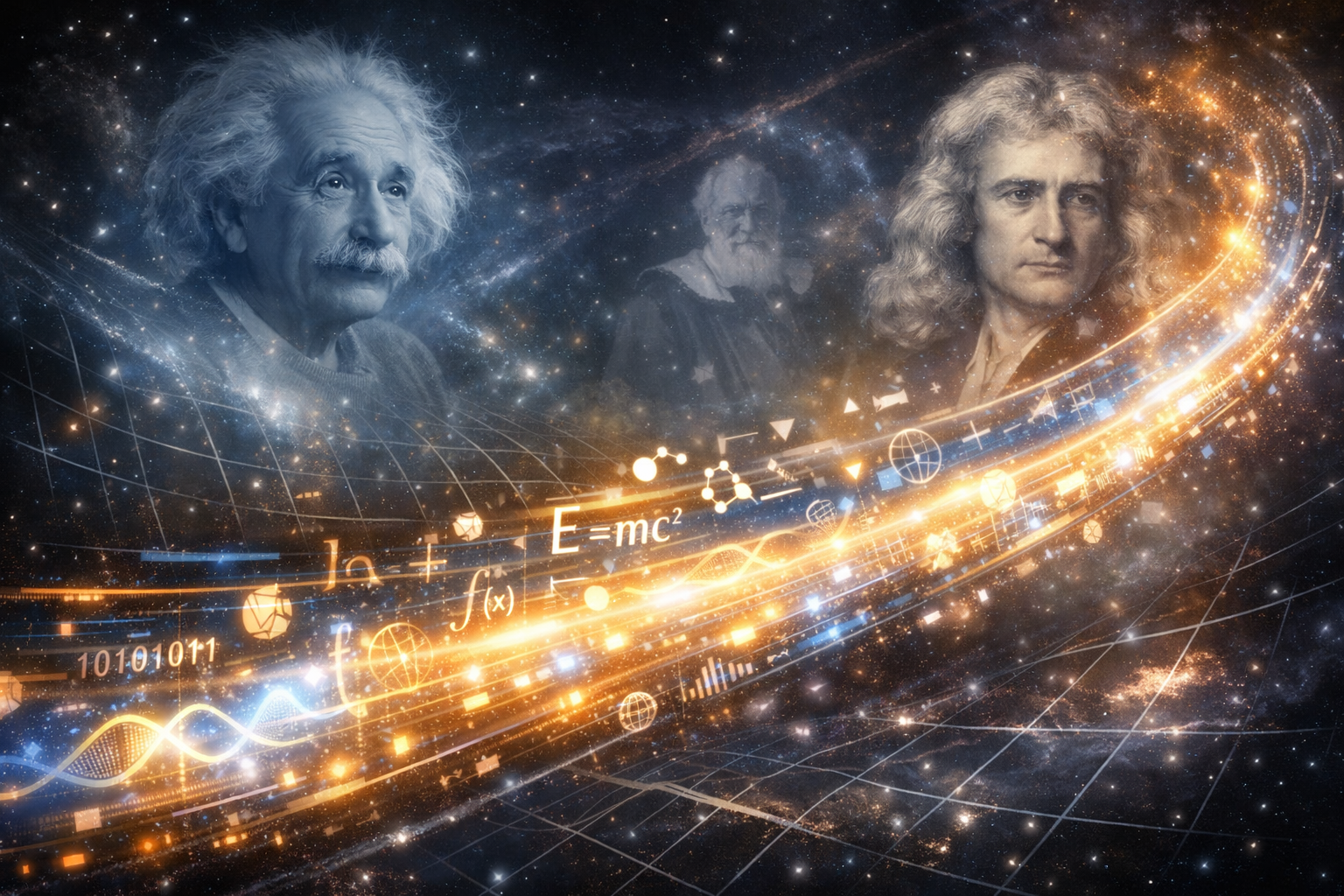
Timeflow is shaped by Gravity:
Modern physics stands on two remarkably successful pillars. One is General Relativity, which describes gravity and spacetime. The other is Quantum Mechanics, which governs the microscopic world. Yet these two frameworks stay mathematically incompatible at the deepest level. One promising bridge between them lies in a deeper understanding of time itself—specifically, how time is shaped by gravity. Timeflow is curved by the density of gravity in space. Time differs across different galaxies, and stars. Because of the gravity of those galaxies and stars. Time can either move faster or slower across space. This helps us to see Gravitational Time-Dilation from a different perspective.
Every physical system experiences its own proper time. While the gravitational influence of an individual human is negligible, it is not zero. Mass and energy contribute to spacetime curvature. As a result, every collection of atoms—no matter how small—exists within a slightly unique temporal framework. Time, thus, may not globally uniform but fundamentally local, shaped by the total energy distribution of the universe. What we experience as a shared flow of time emerges from the near-uniformity of gravitational conditions at human scales.
Another Explanation:
Everyone on earth has their own specific timeframe. Why? A new angle is that you have a miniscule gravitational pull in the galaxy. This gravitational pull exists because you are made up of atoms. And these atoms are intertwined with energy (E=mc^2) Even though this is negligible. So the Gravity that comes from the energy of the densities of objects in space, direct times movement. Everyone having their own time is noted because its implications are not trivial. If time is fundamentally local, global time may be emergent, not fundamental.
How Does Gravity Shape Time?
Gravity is not merely a force acting within spacetime; gravity is the curvature of spacetime itself. Any object with mass or energy contributes to this curvature. Since energy and mass are equivalent (as shown by Einstein), all matter contributes to gravity, even at microscopic scales.
Every atom carries energy.
Every energy density curves spacetime.
Every curvature affects the flow of time.
This implies that every physical system exists within its own local time rate. This rate is determined by the surrounding energy and gravitational environment.
Why This Matters for Quantum Gravity
This is important for quantum gravity. If there were no objects in space, there would be no galaxies, stars, or planets. The only thing that would exist is spacetime. Time would still be evolving in a forward direction. It would move ever so fast and in a straight line. This shows that matter shapes time but does not create it.
Importance: Why is the heavy influence of Gravity on time Important? Because it gives us a new link between Einstein's Theory of General Relativity and Quantum Mechanics.
How?
General Relativity treats spacetime as smooth and continuous. Quantum Mechanics treats reality as probabilistic and discrete. The conflict arises because: Quantum theory requires quantization. Spacetime resists being quantized. As time flows in space, it is curved by gravity. Scientists are yet to discover the units of spacetime. However, for this article, we assume the following:
Hypothesis: Spacetime as a Particle–Wave Structure.
While no experiment has yet identified the “units” of spacetime, one possible approach is to treat spacetime as emergent from microscopic degrees of freedom. This is much like temperature emerges from molecular motion.
Hypothetically: spacetime may be composed of quantum excitations. These excitations may have wave–particle duality. Time itself may propagate probabilistically at microscopic scales
Under this view:
1. gravity acts as a background field
2. gravity shapes the probability flow of these spacetime excitations
3. regions of high energy density constrain and stabilize these fluctuations
Matter as a Result of Temporal Decoherence (Speculative):
One speculative idea is that matter forms where quantum spacetime fluctuations decohere.
In this picture:
1. spacetime excitations remain coherent in low-density regions
2. strong gravitational fields increase decoherence as time evolves.
3. decoherence produces stable, localized structures
4. these structures manifest as matter and energy.
This suggests a deeper layer beneath existing particle physics. In this layer, gravity influences the transition from quantum possibilities to classical reality.
This perspective is valuable because it:
1.preserves Einstein’s geometric gravity
2.respects quantum probabilistic behavior
3.provides a conceptual bridge between the two
4.reframes gravity as a director of quantum structure, not merely a force
It also aligns with ongoing research into:
emergent spacetime
quantum decoherence
vacuum energy
quantum gravity candidate
Final Thought:
Time is not merely a backdrop against which physics unfolds. It is shaped, stretched, slowed, and structured by gravity. A deeper investigation of its emergent properties can hopefully help. It opens our eyes to new perspectives to better understand the link between Quantum Gravity and General Relativity. Oh and also...
Conceptual clarity precedes mathematical unification. Many breakthroughs (entropy, fields, spacetime curvature) began as reinterpretations, not equations.
Predictions (if going deeper)
1. We can make predictions based on loss of interference visibility due to gravitational differences.
2. Predict, “Proper-time decoherence” scales with gravitational time dilation between branches.
3. If spacetime is discrete, there can be irreducible distance/phase noise. So we can predict. -“Spacetime granularity noise” (stochastic metric fluctuations).
(As for spacetime quanta, we can use Discrete Geometry or Postulate that Quanta are "atoms of geometry")

CITATIONS
General Relativity & locality
Einstein, Albert. Relativity: The Special and the General Theory. Translated by Robert W. Lawson, Henry Holt, 1920.
Rovelli, Carlo. The Order of Time. Riverhead Books, 2018.
Emergent Time and Quantum gravity
Rovelli, Carlo. “Time in Quantum Gravity: An Hypothesis.” Physical Review D, vol. 43, no. 2, 1991, pp. 442–456.
Kiefer, Claus. Quantum Gravity. 3rd ed., Oxford UP, 2012.
Spacetime as Emergent
Jacobson, Ted. “Thermodynamics of Spacetime: The Einstein Equation of State.” Physical Review Letters, vol. 75, no. 7, 1995, pp. 1260–1263.
Verlinde, Erik. “On the Origin of Gravity and the Laws of Newton.” Journal of High Energy Physics, vol. 2011, no. 4, 2011.
Decoherence and Emergence of Classical Spacetime
Zurek, Wojciech H. “Decoherence, Einselection, and the Quantum Origins of the Classical.” Reviews of Modern Physics, vol. 75, no. 3, 2003, pp. 715–775.
Joos, Erich, et al. Decoherence and the Appearance of a Classical World in Quantum Theory. Springer, 2003.
Nonlocality without Signaling
Bell, John S. Speakable and Unspeakable in Quantum Mechanics. Cambridge UP, 1987.
Horodecki, Ryszard, et al. “Quantum Entanglement.” Reviews of Modern Physics, vol. 81, no. 2, 2009, pp. 865–942.
Time as Relational/Emergent
Barbour, Julian. The End of Time. Oxford UP, 1999.
Page, Don N., and William K. Wootters. “Evolution without Evolution: Dynamics Described by Stationary Observables.” Physical Review D, vol. 27, no. 12, 1983, pp. 2885–2892.
© 2025 School of Witnesses. All rights reserved.